
Document Intelligence
Classify files, extract fields and tables, identify entities and preserve document structure across PDFs, scans and office files.
Extract information, search across your knowledge, automate workflows and
keep humans in control — all in one secure platform.
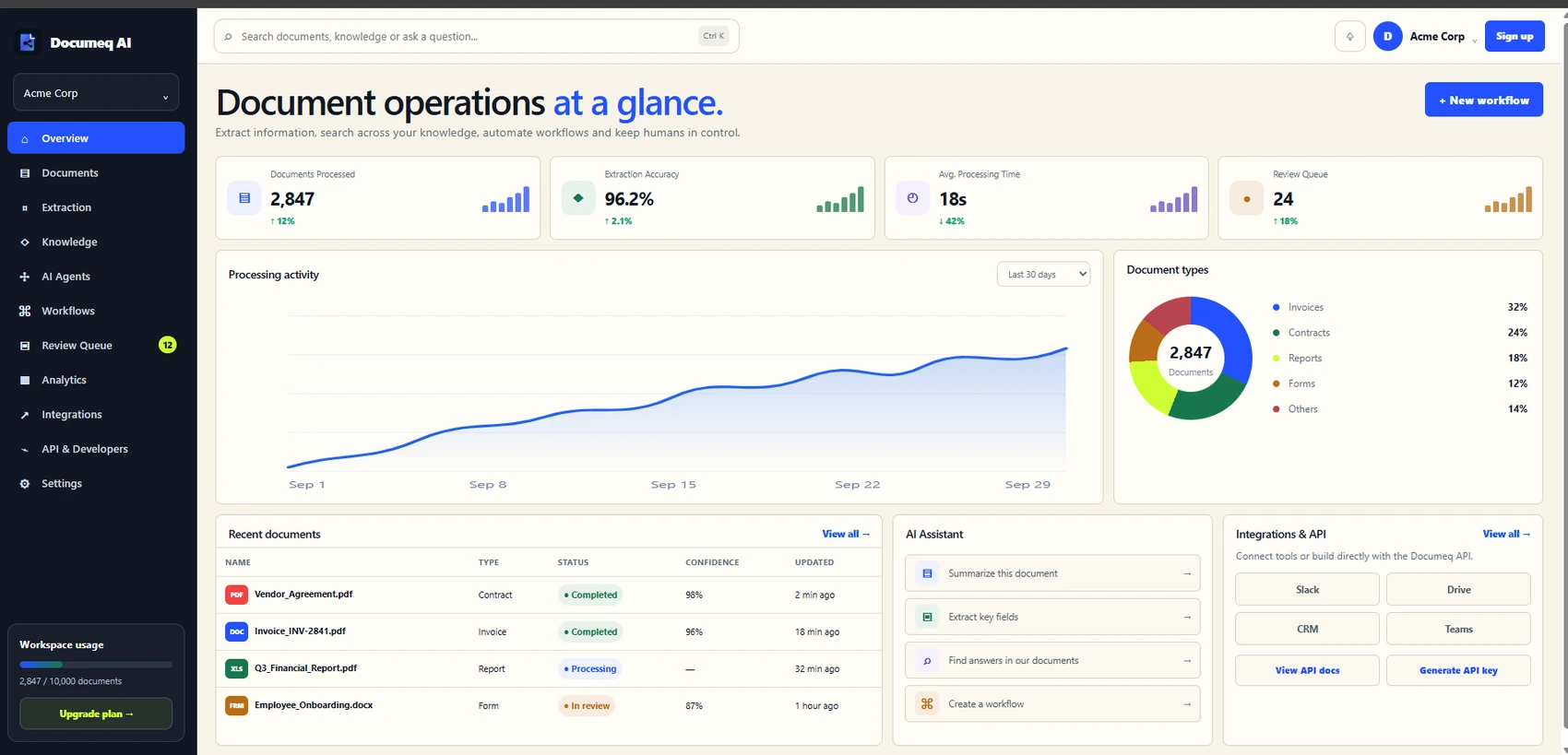
Ingest documents, understand what they contain, search the knowledge they create, route exceptions to people and trigger downstream workflows.
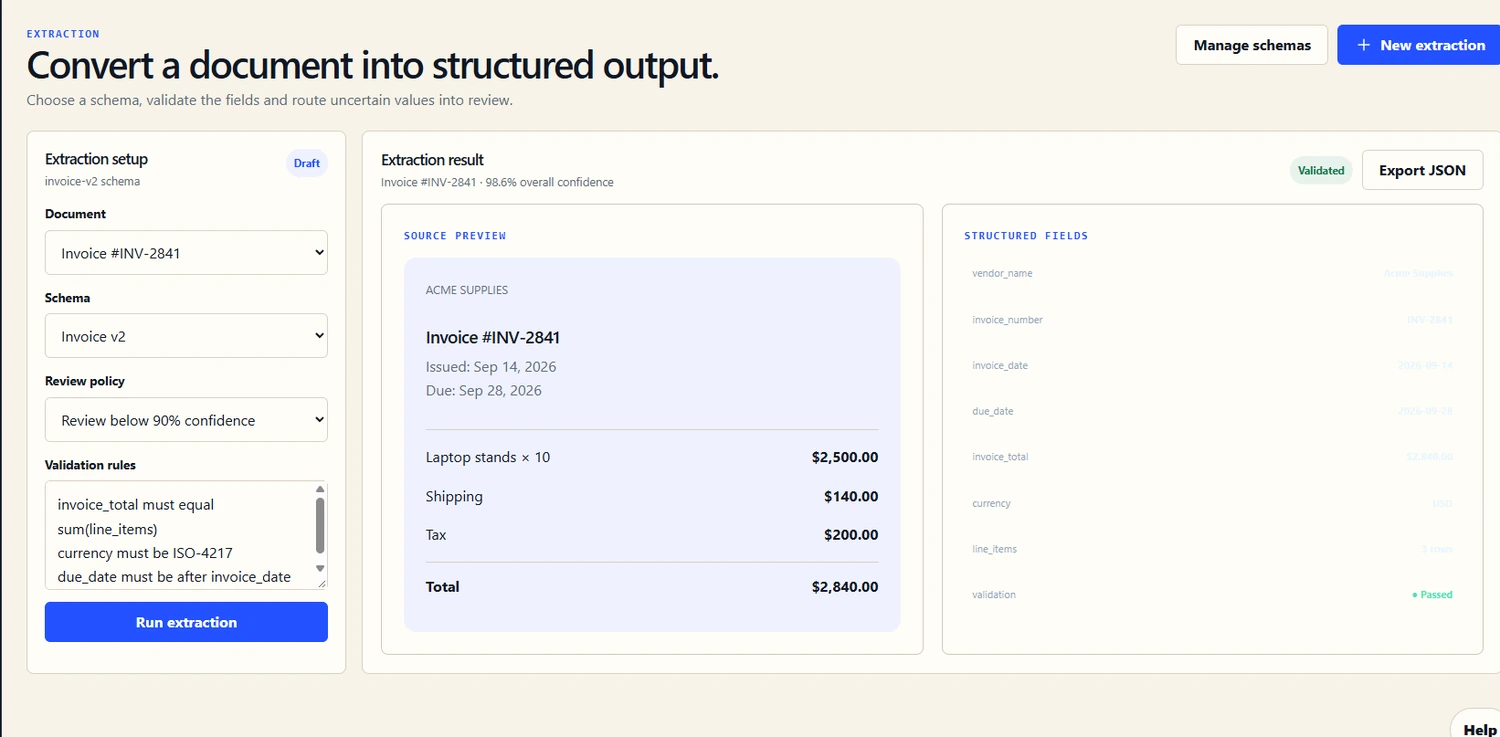
Classify files, extract fields and tables, identify entities and preserve document structure across PDFs, scans and office files.
Ask questions across approved documents and retrieve grounded answers with citations back to the source material.
Give agents business rules, tools and escalation paths so they can review documents and complete multi-step tasks.
Trigger routing, validation, approvals, notifications and API calls when specific document conditions are met.
Send low-confidence fields, sensitive clauses and exceptions to reviewers with the exact context they need.
Track throughput, automation rate, confidence, review time, workflow decisions, API usage and complete activity history.
The same workflow can handle a contract, invoice, policy or report while preserving rules, confidence and review history.
Upload files, receive them through an API, email or connected storage, then route by document type.
Capture fields, tables, entities and clauses, then validate them against schemas and business rules.
Use AI to summarize, compare, classify risk, generate structured context and connect related information.
Escalate exceptions to people or continue automatically into systems, webhooks and operational workflows.
Extract JSON, normalized tables, searchable text, entities, metadata and confidence scores that can move directly into agents, RAG systems and business applications.
Extract clauses, compare terms, identify dates, obligations and renewal risk, then route exceptions for review.
Read invoices, validate line items, detect mismatches and move approved data into downstream systems.
Classify claim files, extract evidence, organize policy context and prioritize cases requiring human attention.
Process purchase orders, supplier documents and statements while enforcing required fields and policy rules.
Turn internal documents into a governed search layer for teams, support systems and AI agents.
Find required evidence, track policy language, flag exceptions and preserve a reviewable audit trail.
The product keeps source files, grounded retrieval and human review inside one connected workspace instead of splitting proof across disconnected tools.
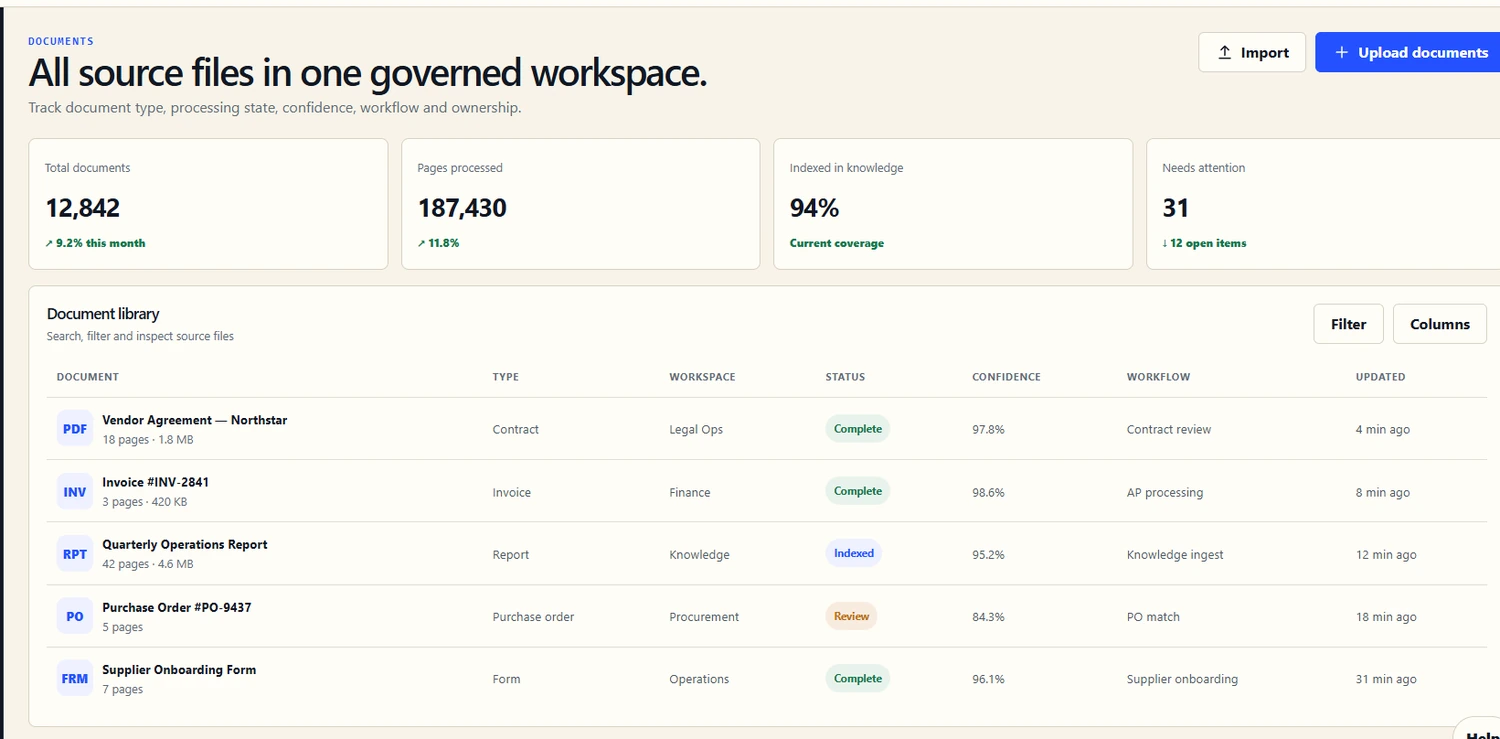
Track processing state, confidence, workflow and ownership from the document library.
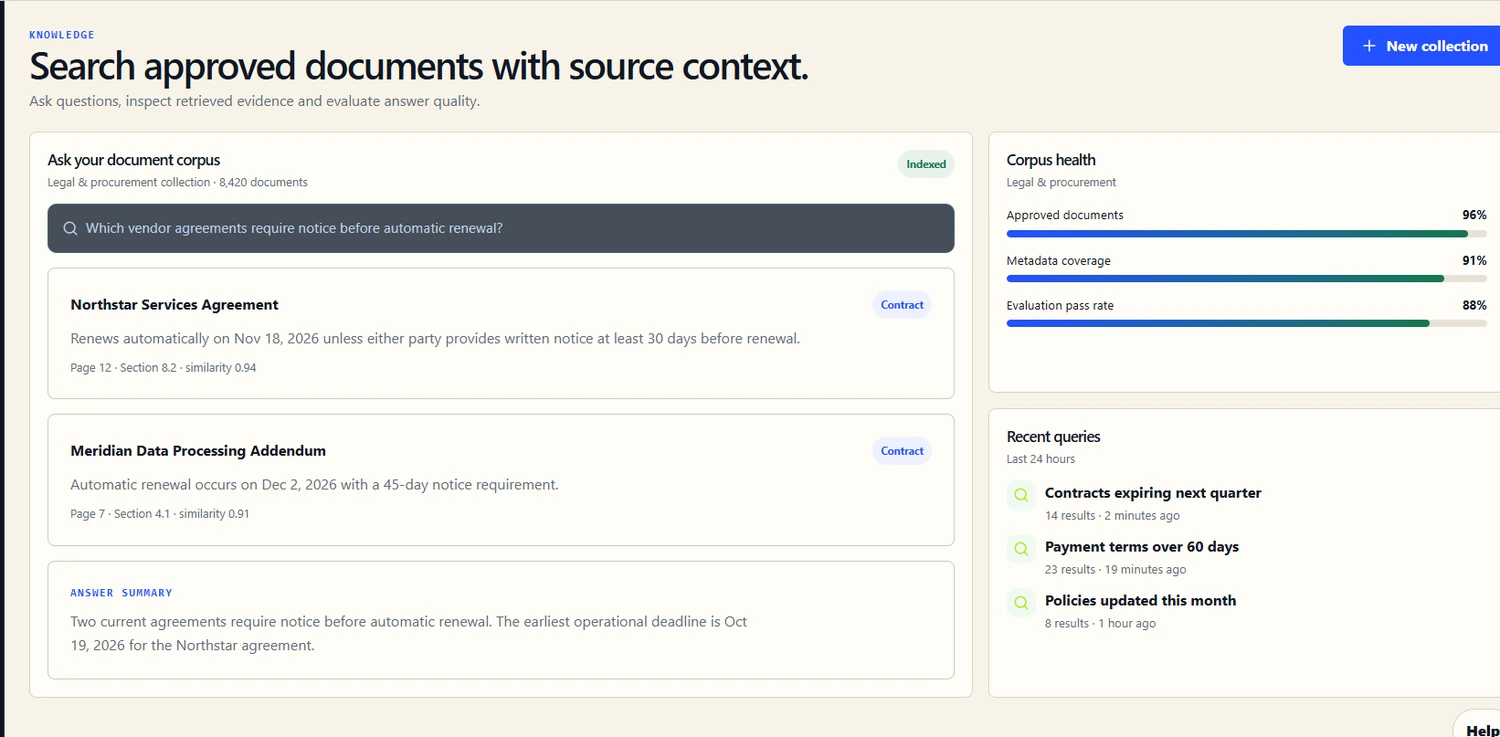
Search approved content and inspect the evidence behind retrieved answers.
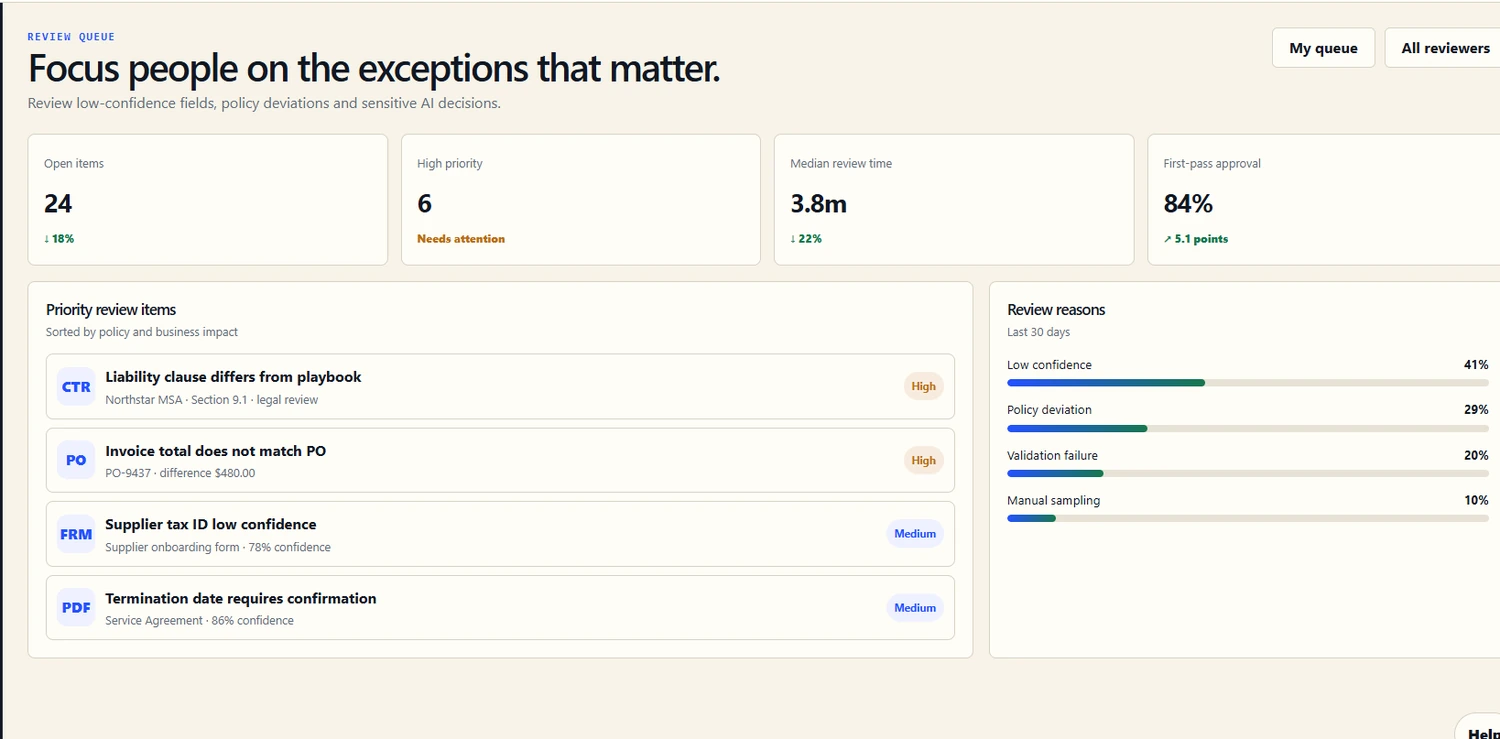
Prioritize low-confidence and policy-sensitive items before they move downstream.
Keep data, reasoning, inference, search, review and workflow execution as distinct layers so the platform can scale without locking every task to one model or cloud.
PDFs, office files, scans, email, APIs, object storage.
Secure upload, classification, validation and preprocessing.
OCR, extraction, reasoning, vision and model routing.
Vector search, metadata, RAG, graph and evaluation.
Planning, tools, workflows, approvals and exception handling.
APIs, webhooks, dashboards, notifications and systems of record.
Use REST endpoints, webhooks and structured schemas for uploads, extraction, knowledge search, workflow execution and review events.
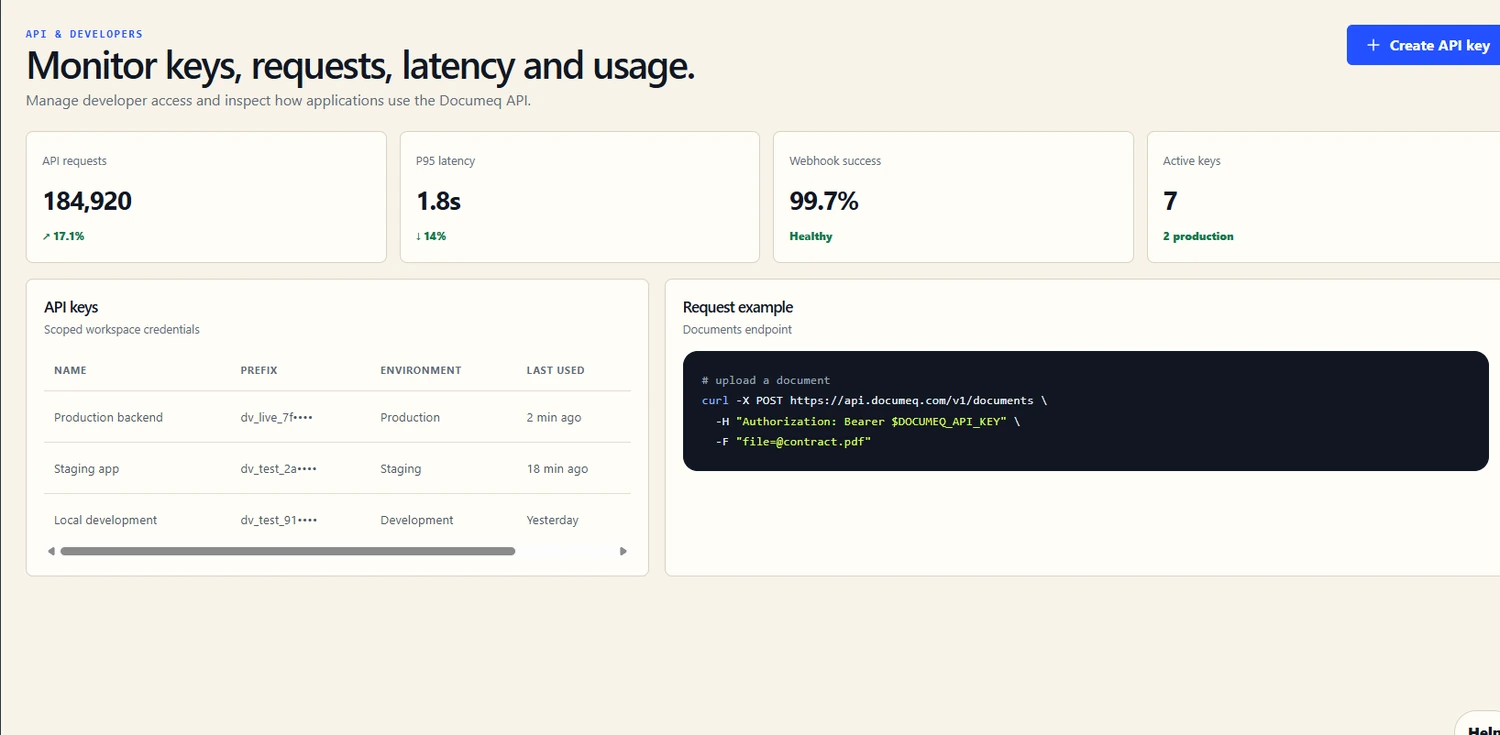
Create a file and receive a document ID.
Choose a schema or workflow and submit the document.
Poll the job or receive a webhook with structured output.
Upload, list, tag, archive and retrieve source documents.
Run schemas, inspect fields, confidence and validation results.
Search documents and request grounded answers with source references.
Trigger workflows, approve reviews and receive webhook events.

“The useful automation is the one your team can inspect, review and explain.”
Documeq keeps source context, confidence, review decisions and workflow history attached to the work so operational speed does not come at the cost of accountability.
Walk through document extraction, grounded knowledge, human review and workflow automation around a process your team already runs.
Contracts, invoices, purchase orders, forms, reports, policies, scanned documents and common office files can all be routed through the same platform with different schemas and rules.
Yes. Field-level confidence, policy rules and workflow conditions can route exceptions into a dedicated review queue with the original source context.
Yes. Search results and AI answers can remain linked to the document chunks, metadata and files that produced them.
Yes. The architecture separates reasoning, extraction, embeddings, batch inference and cloud infrastructure so workloads can be routed according to quality, latency, cost and deployment requirements.
No. The platform is designed around business documents and unstructured information, including PDFs, images, scans, office documents, email attachments and API-delivered files.
Yes. The developer layer includes upload endpoints, extraction jobs, knowledge queries, workflow triggers, webhooks and usage reporting.